Category Archives: Face-to-face Games

Hit Me! 2011 Project list

On Friday, I figured out the doorbell receiver signals and how arduino can tell which doorbell is being rung. Here is the project list which helps me code but also know exactly what goes where. MODE INTERFACE BUTTONS ARDUINO SOUNDS 1. Rest Start Button which goes to Intro Show screenshot of last game Start button Nothing Background loops 2. Intro Intro background Show 2 streaming videos Wait for snapbutton Timer to 3 mins then returns to Rest Exit button Exit button Snapbutton Introduction! 3. Read more [...]

Two Cameras At Once!

I finally purchased the equipment to make the two wireless cameras feed simultaneously into processing.I am using the following set up: 2 x Wireless Security Kit from Geeks.com (they work on different channels around 2.4Ghz) XLR8 XtraView USB (composite video to USB adapter using, driver that comes with it) Canopus ADVC-55 (composite video to firewire adapter, no driver necessary) Read more [...]

Hit Me! 2.0

I will be showing Hit Me! at the next Eyebeam Mixer. I am really excited about it. I need to do some updating to the game. Here is a list of intended updates: 1. Better wireless pin-hole cameras. For the game, I need 2 cameras that are same but run on different channels. I found some rechargeable ones at Geeks that have a choice of 4 different channels around the 2.4 Ghz frequency. Unfortunately I won't know how the system would run in a space until I actually try it out. There are always going Read more [...]

MM5000 Vest

Originally the MM5000 shoulder and thigh pads were made from bandanas and D-rings. However, it's been quite a hassle. They slide off while playing, they take a long time to put on and are equally annoying to take off. So the solution to this problem is to create a vest interface that is much easier to put on and off. And not only does the vest add to the "rocker" feel of the game, but also it provides a nice surface to mount the sensor pads on to. I found some RJ50, also known as 10P10C Read more [...]

To Do List for Kagemusha: Shadow Warrior

Coding: Finish coding game in Processing Research Social Software: check out open source software like Drupal. Need to be able to do following: Can upload photos to Can draw on photos and saves that image Can have people register individually and then create teams Individuals can keep accounts which are then connected to teams Individuals can score or rank images Game results by groups can be posted on a leaderboard Detailed results of a game (score, snapshot, ranking) can Read more [...]

Kagemusha: Shadow Warrior

Kagemusha: Shadow Warrior is a new game I have been working on. It is a stand alone arcade game built with a screen and webcam. The goal is to fill out the shadow of an object as accurately as possible. Scores based on accuracy are kept on a leaderboard. The game structure of Shadow Warrior naturally supports face-to-face interaction, as more details can be filled out when more people are playing at once. This game will experiment with crowd sourcing content for the shadow object database. Read more [...]

Mary Mack 5000: Brainstorming

The most important role of gloves in Mary Mack 5000 is to measure the accuracy of the claps. The technology must be able to assess whether or not the correct claps are being made at the correct time. I first started out mapping out all possible clapping combinations. Ideas like pressure sensor combined with color sensors & colorful gloves or pressure sensors combined with RFID were considered, but ultimately a simple method of ID through contact would be most suitable for the game. Read more [...]

Mary Mack 5000

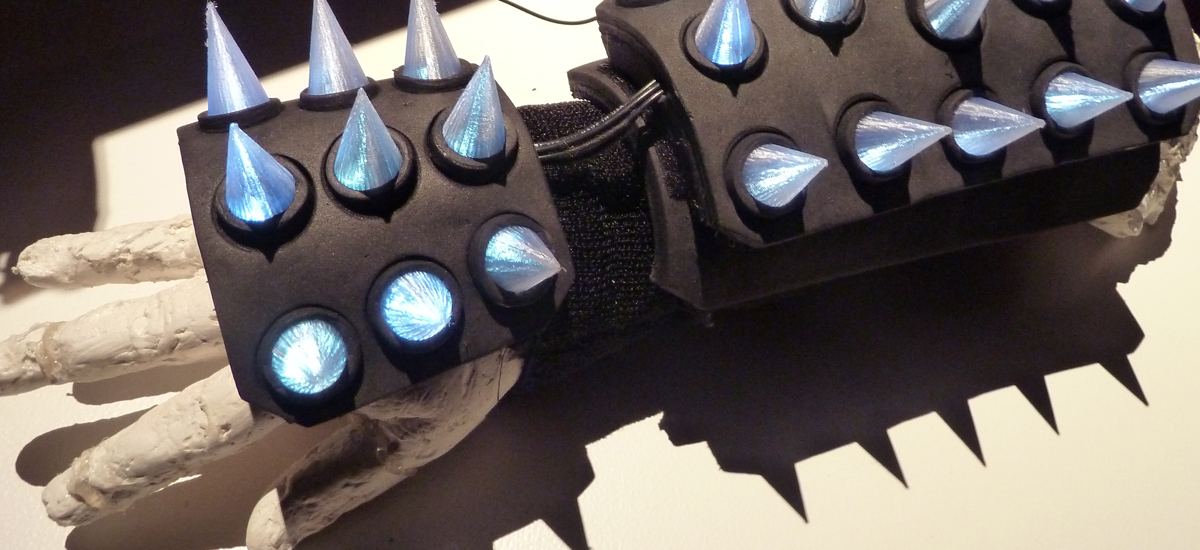
Mary Mack 5000 is a project I have been working on at my Eyebeam fellowship. It's a game that reintroduces the popular Patty Cake little girl's games in a hyper, rocked out, digitized version. It uses special finger-less gloves with conductive pads, as well as pads on the thighs and upper arms. The sensors help measure timing and accuracy of two people playing the clapping game, and the score is based on these two factors. A projected interface keeps the players and spectators informed of the Read more [...]